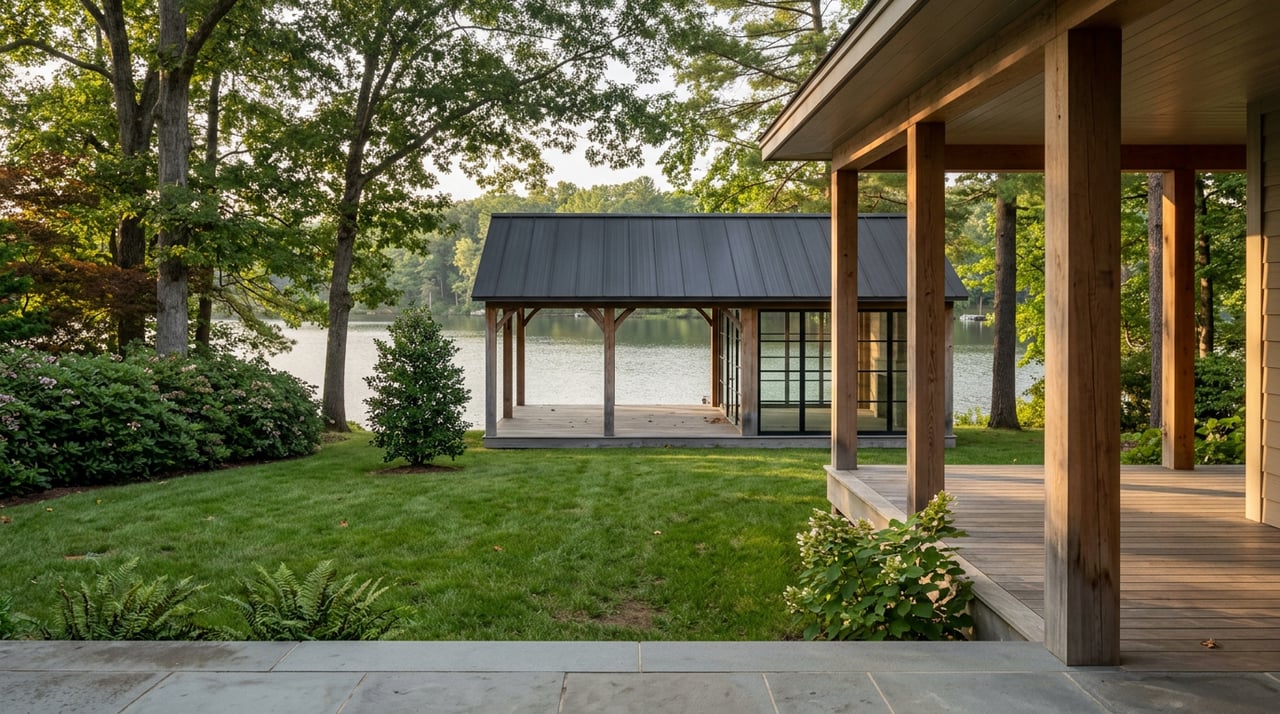
Does it matter whether the deed on your Lake Chatuge home says Georgia or North Carolina? Most buyers assume the answer is no. The lake is the same lake. The mountains ringing it don't stop at a survey line. A dock in Hayesville and a dock in Hiawassee can sit less than a mile apart with the same water lapping at both.
The contract you sign to buy one versus the other is not the same contract. Neither is the tax bill. Buyers who cross-shop both shorelines, which is common on a lake that splits almost evenly between the two states, are often surprised by how much changes the moment they cross into North Carolina, and how little of that difference shows up in a listing description.
The Check Georgia Buyers Never Have To Write
Start with the part that catches people off guard most often. In North Carolina, the standard purchase contract, known as Form 2-T, asks the buyer to pay a due diligence fee directly to the seller at the moment the contract is signed. That money is not held in escrow. It is not refundable if the buyer changes their mind. The North Carolina Real Estate Commission has been explicit about this in its own guidance to agents: the due diligence fee compensates the seller for taking the home off the market, and if the buyer walks away during the due diligence period for any reason at all, the seller keeps it.
Earnest money still exists on top of that, held by the closing attorney and refundable if the buyer terminates during the same window. So a North Carolina buyer under contract on a Hayesville lake home is typically writing two checks with two very different levels of risk attached, one that comes back if the deal falls through and one that does not.
Georgia does not work this way. Buyers on the Hiawassee or Young Harris side of the lake go through a due diligence period too, generally around ten days by custom, but the protection runs through earnest money held in escrow rather than a separate payment made straight to the seller. There is no standard Georgia equivalent of the North Carolina due diligence fee. A buyer who has only ever purchased in Georgia and then writes an offer on a Hayesville property can be genuinely startled the first time their agent explains that the check due at signing is gone the moment ink dries, deal or no deal.
Same Attorney Requirement, Different Assumption
Here is where the instinct to treat North Carolina as the unusual one runs into a wall. Buyers who have heard about the due diligence fee sometimes assume North Carolina is also the state that requires a closing attorney, as if that were the other shoe dropping. It isn't unique to either side of this lake. Georgia has treated real estate closings as the practice of law for decades, and the Supreme Court of Georgia has weighed in on the point directly, meaning a licensed attorney must conduct the closing on the Hiawassee side just as one must on the Hayesville side under North Carolina General Statute 45A-4. Attorney fees on both shores tend to land in a similar range for a standard residential closing.
The two states diverge on how buyer risk is structured during the option period, not on whether a lawyer is in the room at the end.
The Tax Math At The Closing Table
The other place the state line shows up is smaller in dollar terms but worth knowing before you write an offer. North Carolina's deed excise tax runs one dollar for every five hundred dollars of sale price, which works out to two-tenths of one percent. Georgia's real estate transfer tax runs one dollar for every one thousand dollars of sale price, exactly half that rate. On a five hundred thousand dollar lake home, that is one thousand dollars in North Carolina against five hundred dollars in Georgia. Both are customarily paid by the seller, and both are negotiable in the contract, but the default assumption a seller walks in with is different depending on which side of the water the property sits.
| At the closing table | Georgia side (Hiawassee, Young Harris) | North Carolina side (Hayesville) |
|---|---|---|
| Attorney required at closing | Yes | Yes |
| Transfer or excise tax rate | $1 per $1,000 (0.1%) | $1 per $500 (0.2%) |
| Tax on a $500,000 sale | $500 | $1,000 |
| Earnest money | Refundable if buyer terminates in due diligence period | Refundable if buyer terminates in due diligence period |
| Separate fee paid direct to seller at signing | Not part of the standard contract | Due diligence fee, non-refundable once the period begins |
Clay County Just Cut Its Rate. Here's What That Actually Means.
Property taxes add one more layer, and this is where the timing matters, because something changed this year. In June 2026, the Clay County Board of Commissioners approved a budget for fiscal year 2026-2027 that drops the county's property tax rate from $0.43 to $0.27 per $100 of assessed value, following a countywide property reappraisal. Mountain Buzz reported that the new rate ranks as the third lowest among North Carolina's one hundred counties. The fire tax for the Brasstown, Warne, Hayesville, and Shooting Creek fire districts holds steady at $0.04 per $100.
That headline sounds like a straightforward win for anyone buying on the Hayesville side, and it may be, but the county itself described the change as operationally revenue neutral. That word matters. A reappraisal typically raises assessed values across the board, so a lower rate applied to a higher assessed value can land close to where the old rate applied to the old value did. If you see an older estimate online putting Hayesville's effective property tax rate near 0.46 percent, that figure reflects the pre-cut math. What your actual bill looks like under the new rate depends on where your specific property landed in the reappraisal, not just on the rate cut itself.
On the Georgia side, Towns County, which includes Hiawassee, was already running one of the lowest effective property tax rates in the state before any of this, with estimates in the range of roughly 0.37 to 0.43 percent depending on the year and the dataset. Buyers weighing the two shorelines purely on property tax are comparing two counties that both work hard to stay low, just by different mechanisms and different timing.
What This Means If You're Choosing A Shoreline
None of this should talk anyone out of either side of Lake Chatuge. The lake does not care which state owns the mud beneath your dock. But if you are cross-shopping listings and treating the two shores as functionally interchangeable, a few practical habits help.
Ask your agent to walk through the specific due diligence fee amount before you sign anything on a North Carolina property, and understand that number is gone the day you sign, not the day you close. Do not assume the attorney requirement is the differentiator, since both states share it. Build the doubled excise tax rate into your North Carolina closing cost estimate rather than assuming it mirrors what a Georgia contract would show. And treat any single property tax rate you find online as a snapshot, especially on the Clay County side this year, where a reappraisal and a rate cut landed in the same budget cycle.
The state line runs straight through a body of water that has no idea it's there. The paperwork on either side of it does.
FAQ
Does the North Carolina due diligence fee replace earnest money? No. They are two separate payments serving two different purposes. The due diligence fee goes directly to the seller and is non-refundable once the due diligence period is underway. Earnest money is held in escrow and is refundable if the buyer terminates properly within that same period.
Is Georgia's due diligence period the same protection as North Carolina's? Not exactly. Georgia buyers get a similar window to inspect and reconsider, but the money at risk is earnest money in escrow rather than a separate fee paid straight to the seller. The practical effect on a buyer's exposure can differ even when the calendar length looks similar.
Did Clay County's rate cut mean Hayesville property taxes just got cheaper? Not automatically. The county reduced the rate alongside a countywide reappraisal and described the change as revenue neutral overall, meaning many bills may land close to where they were even though the rate itself dropped. Your specific bill depends on how your property's new assessed value compares to its old one.
Whether you are drawn to a cove on the Hayesville side or a view from the Hiawassee shoreline, the details in the contract are just as much a part of the decision as the view from the dock. The Lucretia Collins Team is licensed in both Georgia and North Carolina and works this exact stretch of the state line regularly. Let's Connect and talk through what the paperwork actually looks like on the shore you're considering.


